| Retired Females |
Males | Alpaca Facts |
Word Barn |
Link Library |
About Us |
Contact Us |
return Home |

 |
|
|
|||||||||
|
|
As a livestock industry, there are unique terms associated with alpacas...
agist: board alpacas at a ranch; used originally of the feeding of cattle in the king's forests, and collecting the money for the same. allele: the pairing of genes — dominant 'AA', recessive 'aa' or mixed dominant-recessive 'Aa' alpaca "gold" (aka alpaca manure): It has balanced levels of plant nutrients nitrogen and potassium, but has relatively low organic content and nitrogen levels as well, avoiding the need for composting and enabling farmers to throw alpaca gold directly into the soil without fear of burning the plant. Considered a soil conditioner, alpaca manure helps soil’s ability to retain water in addition to improving the ground's overall quality. Cow manure's high levels of nitrogen and phosphorus, on the other hand, can create algal blooms or toxins harmful to drinking water caused by fertilizer runoff.
altiplano: the foothills of the Andes moutains in Peru, Chile, and Bolivia, original home of alpacas ~ "New World camelids" Aragon: region of Spain; symbolized by the native pomegranate, a fruit of bounty [see the Name Dance] blanket: prime fleece on the main body of the animal; best quality for spinning breed back: a breeding with any herdsire from the ranch from which a pregnant female is purchased, following her delivery; offered in contracts as a three-in-one deal. brightness [of fleece]: the quality of alpaca fiber that reflects light camelid: mammal family to which the alpaca belongs; also includes camel, llama, vicuna, and guanaco colostrum: the initial rich milk produced by a new mother soon after delivery; vital to stimulate immunities in the newborn [see IgG] conformation: the appropriate alignment of the alpaca's body structure in proportion to the whole animal
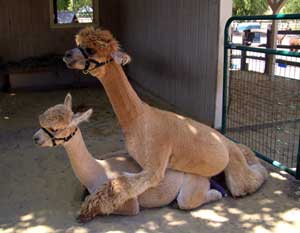
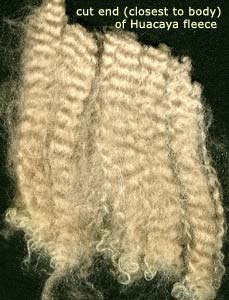
cria: an unweaned camelid baby; from old Spanish word for "create." crimp: the wavy crinkle of fiber strands from a Huacaya alpaca [see photo of fleece below] cush: upright resting position, sitting with all legs tucked under; sometimes spelled 'kush.' A female ready for breeding will cush for the male so he can get into position behind her. dam: female parent fhleming: male behavior of sniffing pasture areas (especially the poop pile) where females have been, lifting their nose into the air to inhale the scent, much as a person would test the aroma of a wine fiber: the product of shearing an alpaca; interchangeable with 'fleece;' never referred to as 'fur' or 'wool.' fighting teeth: the tiny sharp teeth that grow mid-jaw in adult alpacas; males use them to render other males in the herd impotent. These teeth are filed down in a managed herd situation.
gelding: a castrated male guard hair: the longer, medulated single hairs interspersed with the finer fiber on a huacaya alpaca or llama
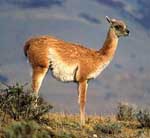
guanaco: the rarest relative of the alpaca, native to the Andes hembra: adult female alpaca herdsire: adult male alpaca used for breeding
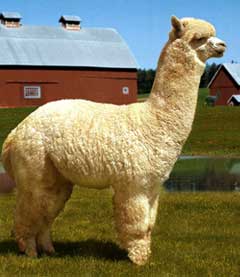
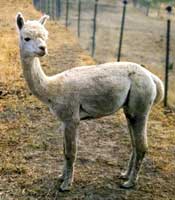
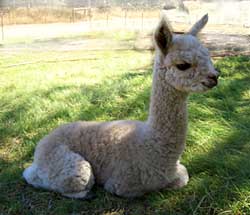
huacaya (wah-KI-yah): one of two types of alpaca, with thick, fluffy fleece suggesting the 'teddy bear' look humming: the most common audio communication between alpacas; a melodic, purring sound that indicates nervous attention, as a mom calling to her cria, or an adult separted from the herd. husbandry: the watchful care and intervention by humans to the herd for optimal health maintenance; vaccinations, toe-nail trimming, nutrition, protection, etc. ideal alpaca: perfect in every sense of conformation — proportional body, straight legs, dense fleece, overall coverage, crimpy fiber, presence and stature, aligned teeth. IgG: Immunoglobulin G; a blood test during the first days of a cria's life determines IgG levels, to monitor absorbtion the necessasry colostral antibodies from its mothers milk. improved alpaca: the overall look of the animal is balanced and typey induced ovulator: the female is stimulated by the breeding process to release an egg for fertilization; cats are also induced ovulators, different from a female cycle that the male then responds to. junior herdsire: intact young adult male alpaca, not yet mature for breeding lama: umbrella term for sub-category of camelids that includes llamas and alpacas. An alpaca is a lama. llama: larger cousin of the alpaca. A llama is a lama. luster: the rich gleam of the Suri's silky fiber macho: adult male alpaca maiden: young adult female, not yet bred medulated fiber: the thicker, hollow-shaft fiber that sometimes populates the fleece and sticks out beyond the finer, crimped fleece of a Huacaya micron: one-millionth of a meter; referring to the width of single fiber of alpaca fleece micron count: the average of measurements within a fiber sample orgling: the trumpeting love song that a male sings to the female during breeding orchard grass: low-protein grasses either growing in the pasture or baled as hay; not alfalfa pasture breeding: placing a male in a pasture with females in a to breed 'at will' according to their maturity and readiness; less human involvement than with pen breeding.
pen breeding: purposefully placing one male and one female in a pen together with the intention of breeding Ppperuvian: the 3 "p's" indicate the third Peruvian import of alpacas into the US primitive alpaca: one whose overall conformation and structure is out of symmetry pronk: romping, cavorting and prancing behavior, especially between young animals proven: an animal, either male or female, who has successfully parented an offspring retained CL: "corpus lutum" = yellow body, referring to the casing of the unfertilized egg. When not shed by the body (i.e., retained), hormones may still respond, thus giving a "false pregnancy" reading when spit-testing (see below). roving: fiber that has been cleaned, carded and rolled (much like a clay 'snake'), ready for spinning ruminant: having a multiple stomach digestive system, maximizing low-quality food sources shearing: the annual clipping of the fleece off of the animal
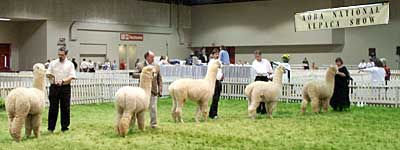
show ring: events sponsored by by national and regional organizations to judge the quality of animals; show divisions are by type, fleece color, age and gender
sire: male parent spinning: creating yarn from the fleece — using a spinning wheel or a drop spindle — to be woven, knitted, crocheted or felted into clothing and accessory items spit test: parading a bred female in front of a potent male. If she 'spits him off, ' his services no longer interest her. This is a low-level pregnancy test.
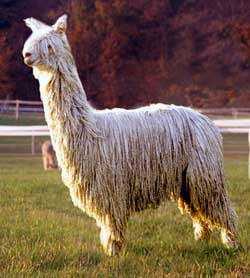
suri : one of two types of alpacas, marked by silky fleece that hangs in long, curled pencil 'dreadlocks' tui [too-ey] fleece: softest first fleece sheared from a young cria typey: refers to 'ideal' look, with good conformation and proportional balance of body parts: legs, body, neck and head of similar height and relative to overall body length. Visual test: animal 'fits in a box.' unimproved: an alpaca with characteristics more 'primitive' than 'ideal,' such as camel-like head and face, banana-shaped ears, elongated body unproven: an animal that has not yet participated in breeding; if female, has never been pregnant; if male, he has not yet impregnated a female; no offspring has been born.
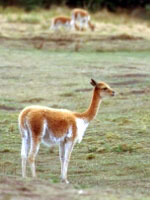
vicuña coloring: red-brown above with cream under neck, belly and insides of legs; referred to in Huacaya alpacas that probably carry vicuña genes. weanling: a newly weaned alpaca, usually at least six months old but less than one year.
|
|
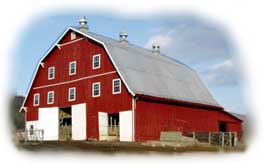 Accoyo:
the Peruvian ranch of the world-famous alpaca breeder,
Accoyo:
the Peruvian ranch of the world-famous alpaca breeder, 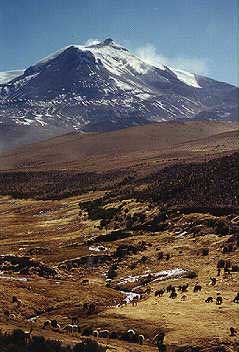
 fleece: the fiber of an alpaca; lanolin-free. Huacaya
fiber is crimpy, while fleece of the Suri alpaca is silken.
fleece: the fiber of an alpaca; lanolin-free. Huacaya
fiber is crimpy, while fleece of the Suri alpaca is silken.